
Cybersecurity Career Roadmap for Beginners

Cybersecurty professionals monitoring network security systems
Cybersecurity is consider to be one of the fastest-growing industries globally, but many people struggle to understand where to start.
The field includes a wide range of roles, from technical security operations to governance, risk management, compliance, and privacy.
Many beginners assume cybersecurity is only about hacking or techical tools. In reality, protecting organisations involves understanding how technology, information, and people interact.
This roadmap explains the main cybersecurity career paths, beginner-friendly roles, and the practical skills needed to start building a career in the industry.
What Cybersecurity Actually Means
When most people hear the term cybersecurity, they imagine hackers, firewalls, or antivirus software.
Cybersecurity does involve protecting systems and networks from external attacks. However, focusing only on technology misses the bigger picture.
Protecting an organisation actually involves three interconnected layers as noted by Marnie McLeod, one of our Co-Founder in her latest book “Don’t Let Your Business Get Cooked”. Marnie explains it as follows:
Cybersecurity Layer
Cybersecurity focuses on protecting systems, networks, applications, and infrastructure from external digital attacks.
Examples include:
ransomware attacks
phishing campaigns
malware infections
unauthorised system access
These are the types of threats most commonly discussed in the media.
Information Security Layer
Informaition security is broader than cybersecurity. It focuses on protecting all information assets, whether digital or physical.
This includes:
customer data
employee records
organisation’s financial information
intellectual property
operatonal processes
Information security addresses how information is collected, stored, accessed, and shared within an organisation.
Many incidents occur not because of sophiscated hackers, but because of internal processes, human error, or poor access control.
Privacy Layer
Privacy focuses on protecting people’s personal and sensitive information. It ensures organisations collect and use data:
lawfully
transparently
responsibly
Privacy regulations increasingly require organisations regardless of size to demonstrate how they protect the information they collect and use.
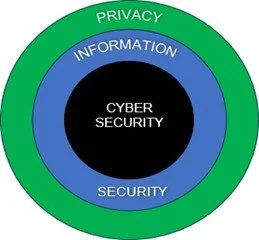
Image sourced from “Don’t Let Your Business Get Cooked”
Why This Matters
Many organisations focus only on techical cybersecurity tools. However, reach consistently shows that human behaviour and operational processes are responsible for a large proprortion of security incidents.
This means cybersecurity careers often involves understanding not only technology, but also risk management, governance, and organisational decision-making.

Major Cybersecurity Career Paths (Including New Roles for 2026)
Cybersecurity includes many different career paths. Each focuses on a different aspect of protecting organisations.
Security Operations - focuses on monitoring systems and responding to threats. Beginner friendly rating = Medium barrier as usually requires 1-2 years in general IT experience (Help Desk or Networking)
Governance, Risk & Compliance (GRC) and Privacy - focuses on risk management, regulations, company policies and procedures, compliance, and information securityand privacy strategies. Beginner friendly rating = Low barrier as it is great for career-changers with legal or business background
Penetration Testing - focuses on finding holes in a network and performing vulnerability testing. Beginner friendly rating = High barrier as ususally requires a background in software development so need advance skills
Security Engineering - focuses on designing and implement security software. Beginner friendly rating = High barrier as usually requires a background in software development.
Cyber Architect - focuses on designing the entire security strategy. Beginner friendly = Expert barrier as usually requires 7 to 10+ yeasrs of broad experience
Cloud Security - focuses on securing cloud platforms such as AWS, Azure or Google Cloud. Beginner friendly = Medium barrier as how cloud works must be understood before permitted to fix it
AI Security Engineer - focuses on protecting the “brains” of the comany’s new AI tools. Beginner friendly = High barrier ususally requires technical skills suchas proficiency in Python for automation and familiarity with AI frameworks like TensorFlow or PyTorch and knowlege of OWASP Top 10 for LLMs (prompt injection, data poisoning)
API Security Specialist - focuses on securing the connections between cloud apps. Beginner friendly = Medium to High barrier ususally requires deep knowledge of REST, GraphQL, and gRPC protocols and proficiency in “Identity-First” security.
AI Risk & Governance Specialist - focuses on performing AI impact assessments and audit model training data for bias. Beginner friendly = Medium as it usually requires deep understandign of reguations and AI riks management framework.
IAM Architect - focuses on managing “Zero Trust” logins across global teams. Beginner friendly = Expert barrier and is not an entry-level role as it typically requires 7-10 years in IT and 3+ years in architecture.
Understanding these paths can help you decide where your interests and strength align.
Beginner-Friendly Cybersecurity Roles
Many cybersecurity professionals do not start in highly technical roles. Instead, they often begin in positions that build foundational knowledge about security, systems, and risk.
Some of the most common entry points include:
SOC Analyst (Security Operations Centre Analyst)
SOC Analyst monitor systems for suspcious activity and help respond to security incidents. They work with tools such as SIEM platforms, threat intelligence feeds, and monitoring dashboards. This role helps develop a strong understanding of how attacks are detected and investigated.
Governance, Risk and Compliance (GRC) Analyst
GRC professionals focus on helping organisations manage risk and meet regulatory or contractual requirements. Typical requirements include conducting risk assessments, reviewing policies and procedures, supporting compliance audits, managing third-party risk, assisting with incident responses, and setting up and conducting security awareness training. GRC roles are often accessible to beginners who enjoy analytical thinking and structured problem solving.
Security Analyst
Security analyst help identify vulnerablities and strengthen organisational security practices. Their work may involve reviewing alerts and security reports, analysing vulnerabilities, and assisting with incident invesitigations.
IT Support or Systems Administration
Many cybersecurity professionals begin their career in IT support adminstration roles. These positions help build important technical knowledge about operating systems, enterprise environments, and networking infrastructure. This foundation knowledge often provides a strong pathway into security roles later.
Core Skills Beginners Should Learn
Instead of focusing only on certifications, beginners should focus on developing fundamental knowledge and practical skills.
Networking Fundamentals
Understanding how functions does help security professionals detect abnormal behaviour and investigate incidents. Important concepts include: TCP/IP, DNS, routing, and network traffic analysis.
Security Principles
Cybersecurity professionals should understand foundation concepts such as confidentiality, integrity, and availability (CIA), identity and access management, authentication and authorisation, and encryption fundamentals.
Risk Management
Cybersecurity is ultimately about managing risk. Security professionals must evaluate threats (internal and external), vulnerablities, and potential impact. This helps organisation prioritise which risks require attention.
Communication and Decision-Making
Many cybersecurity incidents involve human decisions and organisational processes. Professionals must be able to explain risk clearly, support leadership decisions, ability to communicate reports to business leaders, ablity to write reports for executives, ability to critical think on AI security outputs, and balance security with business operations.

A Step-by-Step Roadmap into Cybersecurity
A typical beginner journey into cybersecurity may follow these steps.
Step 1 - Learn IT Fundamentals
Understand how technology environments work provides a foundation for cybersecurity. This includes operating sytems, networks, and system administration basics.
Step 2- Understand Security Concepts
Learn how threats occur and how organisations defend against them. Focus on practical security concepts such as risk assessment, incident response, access control, and security monitoring.
Step 3 - Practice with Labs and Projects
Hands-on practise is essential. Practical exercise help develop conifdence, learn industry lingo, and gain real-world understanding of security concepts. To even, help your knowledge further obtain an understanding of privacy regulations as organisation are required to comply or they face fines and may even be publicly humilated for not following laws that protect customers and employees data.
Step 4 - Deveop a Portfolio
Projects can demonstrate your skills and knowledge to potential employers. Examples include: conducting and interrupting risk assessments, security documentation, and incident analysis exercises.
Step 5 - Apply for Entry-Level Roles
With foundation knowledge and practical experience, you can begin applying for entry-level roles in cybersecurity. Further suggest offering to do volunteer work placement to organisations you’re attracted to work for. Employers increasingly value candiates who demonstrate problem-solving ability and practical understanding, not just certifications.

How Cyber Rookie Helps Beginners
Cyber Rookie was created to help aspiring cybersecurity professionals build practical skills and real-world understanding.
The program focuses on helping beginners:
understand cybersecurity career pathways
develop practical knowledge
build confidence through hands-on learning
prepare for real industry roles
Cyber Rookie provides a supportive learning environment designed specifically for people starting their journey into cybersecurity.
Start Your Cybersecurity Journey
Cybersecurity can feel complex when you first enter the field. However, with the right support from coaches that work in the industry and structured learning path, it becomes much easier to navigate.
By understanding the different career path, building foundational skills, and gaining simulated practical experience, you can begin building a meaningful career in cybersecurity.
Every professional in this field started as a beginner. The key is simply starting the journey and continuing to build your skills over time.
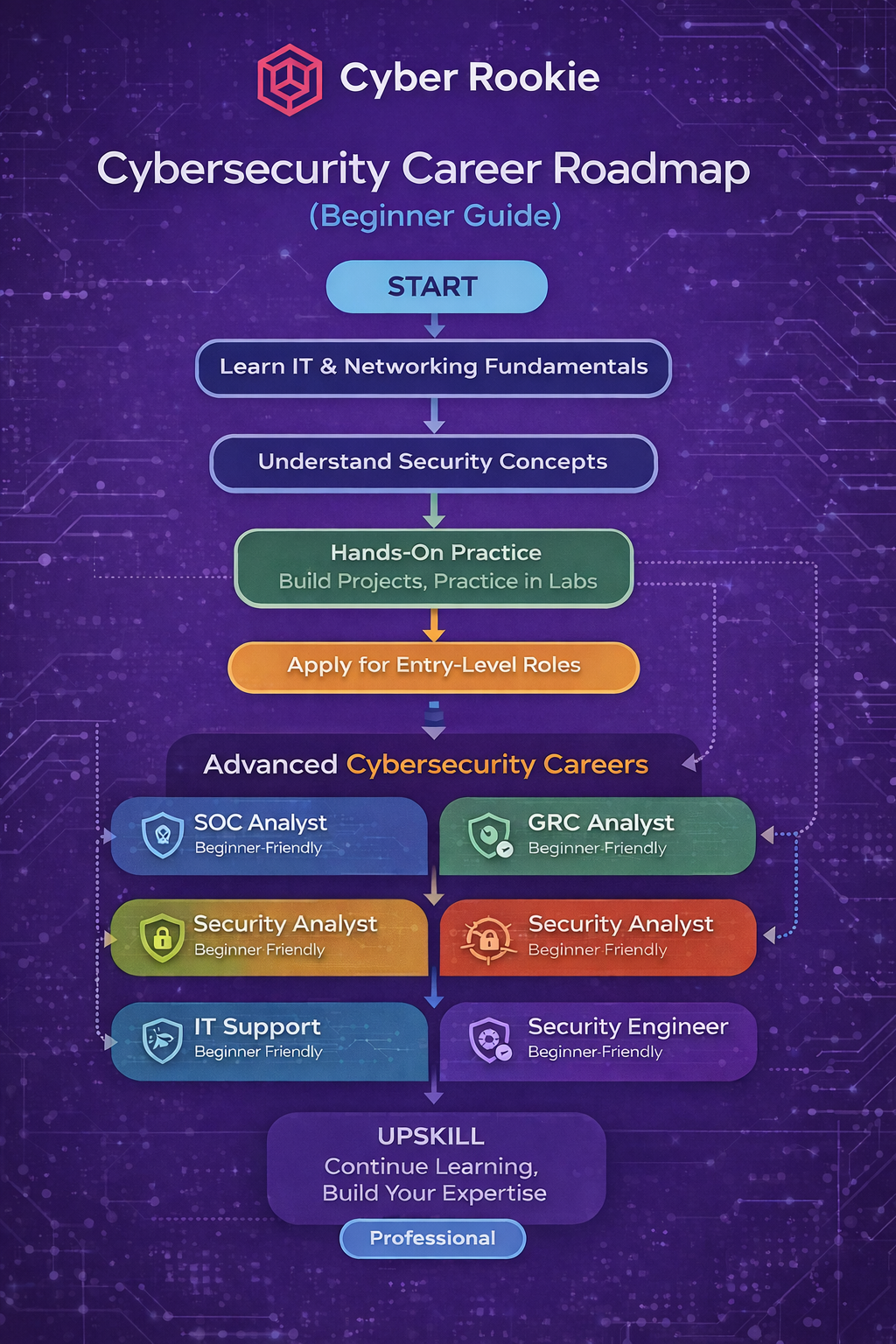
Cyber Rookie Cybersecurity Career Raodmap for beginners showing the journey from foundational skills to cybersecurity career paths.
People Also Ask
Common questions about starting a cybersecurity career
Do you need coding to start a cybersecurity career?
1
No. Many cybersecurity roles such as Governance, Risk, and Compliance (GRC) focus on risk management, policy, and compliance rather than programming
What is the easiest cybersecurity job for beginners?
2
Many beginners start as SOC Analysts, GRC Analysts, or Security Analysts because these roles focus on monitoring, analysis, and risk management rather than advanced penetration testing.
How long does it take to start a cybersecurity career?
3
Many people can transition into entry-level cybersecurity roles within 6–12 months depending on their background and the time they invest in learning.
A degree can help especially for management positions, but many professionals enter the field through certifications (even without certifications), practical experience, and hands-on learning.
Do you need a degree to work in cybersecurity?
4
Will AI replace cybersecurity jobs?
5
No. AI is changing how cybersecurity professionals work, but it is unlikely to replace them.
Cybersecurity requires human judgement, risk assessment, and decision-making. AI tools can assist with analysing alerts, identifying patterns, and automating routine tasks, but security professionals are still needed to interpret results, manage risk, and respond to incidents.
In many cases, AI is actually increasing the demand for cybersecurity professionals because organisations must secure AI systems and manage new types of risks. Suggest to review ISO42001 - AI Management System, NIST AI Risk Management Framework, and privacy regulatory AI guidelines.
Is AI making cybersecurity careers obsolete?
6
AI is not making cybersecurity careers obsolete. Instead, it is changing the skills that security professionals need.
Many security tools now use AI to analyse large volumes of data and detect threats faster. However, these tools still require skilled professionals to interpret results, investigate incidents, and implement security strategies.
Cybersecurity professionals who understand both security principles, privacy compliance, and emerging technologies like AI will be highly valuable in the future.
Will AI reduce the need for entry-level cybersecurity jobs?
7
AI may automate some repetitive security tasks, such as basic alert triage. However, entry-level roles will still exist because organisations need people who understand how security systems work, understand privacy compliance, interpret automated bias, and how incidents should be handled.
Many entry-level professionals will focus more on:
analysing alerts
investigating incidents
understanding risk
improving security and privacy processes
These skills cannot be fully automated
What cybersecurity jobs are least likely to be replaced by AI?
8
Roles that involve human judgement, communication, and decision-making are the least likely to be replaced by AI.
Examples include:
Governance, Risk and Compliance (GRC)
Security architecture
Incident response leadership
Risk management
Privacy and data protection strategist
These roles require understanding business context, legal obligations, and organisational priorities.
Should beginners learn AI for cybersecurity careers?
9
Understanding AI concepts can be helpful, but beginners should first focus on building strong cybersecurity fundamentals.
Important foundational skills include:
networking fundamentals
security principles
risk management
incident response
access control
privacy compliance
Once these foundations are established, learning how AI tools are used in security can become an additional advantage. Plus suggest to review ISO42001 - AI Management System, NIST AI Risk Management Framework, and privacy regulatory AI guidelines.
Is cybersecurity still a good career with AI?
10
Yes. Cybersecurity remains one of the fastest-growing technology careers.
As organisations adopt AI technologies, new security and privacy challenges are emerging, including:
protecting AI systems from attacks
securing training data
managing AI-generated risks
preventing misuse of AI tools
These challenges are creating new opportunities for cybersecurity professionals rather than eliminating them.